
'During the hot season (April to June), above-normal minimum temperatures are likely over most parts of the country, except in some regions of Maharashtra and Telangana, where minimum temperatures are expected to be normal to below normal,' IMD said.

The India Meteorological Department (IMD) has predicted that the June-September southwest monsoon seasonal rainfall over India is expected to be 90 per cent of the long-period average. While the Northeast is likely to witness normal rainfall, the remaining parts of the country may see below normal rainfall.

The India Meteorological Department (IMD) has predicted below normal monsoon rains for India this year, citing the potential emergence of El Nino conditions. This could significantly impact the country's agriculture-dependent economy.

The India Meteorological Department has forecast intensified heavy rains and thunderstorms for Mumbai and its suburbs. A yellow alert has been issued, and high tides are expected, though traffic and public transport are currently normal.

'This system will be of immense help in agricultural planning, disaster management and water resources management.'

Authorities on Sunday temporarily suspended the Amarnath Yatra in Kashmir as well as the pilgrimages to the Mata Vaishno Devi and Shiv Khori shrines in Jammu after the India meteorological department (IMD) forecast of widespread rainfall across the Union Territory over the next few days.
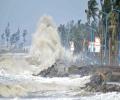
The India Meteorological Department (IMD) has announced that conditions are becoming favourable for the onset of the southwest monsoon over parts of the south Bay of Bengal, Andaman Sea, and Andaman and Nicobar Islands towards the end of this week.

Mumbai is experiencing intense monsoon activity, with over 100 mm of rainfall recorded in 24 hours, leading to widespread waterlogging and two tragic rain-related deaths, as the India Meteorological Department forecasts continued heavy to very heavy showers and gusty winds.

The India Meteorological Department (IMD) has issued an orange alert for Mumbai, predicting heavy to very heavy rainfall, thunderstorms, lightning, and gusty winds for the next few days. The forecast extends through Friday, with a brief yellow alert on Tuesday. Neighbouring Palghar is under a red alert, and Raigad is under an orange alert for five days.

The India Meteorological Department (IMD) has predicted below-normal rainfall for India during the second half of the southwest monsoon season, specifically from August to September. This forecast indicates less than 94 per cent of the Long Period Average (LPA) for the period. While July saw good rainfall activity due to low-pressure systems and the Madden-Julian Oscillation, the Southern Peninsula experienced significantly low rainfall and record high minimum temperatures.

The administration has been put on high alert following the India meteorological department's (IMD) forecast of extremely heavy rainfall across several districts of Gujarat in the next two days.

After being pummelled by heavy downpours at the start of the week, Mumbai witnessed a brief respite on Tuesday morning, with the island city recording an average rainfall of 106 mm in 24 hours, civic officials said.

As Mumbai grapples with rising temperatures and humidity, many slum dwellers are spending their nights on Versova beach to escape the unbearable heat in their poorly ventilated homes, with the India Meteorological Department (IMD) forecasting a gradual rise in temperatures before a decline, and a yellow alert for isolated rainfall.

The India Meteorological Department has issued a red alert for Mumbai, forecasting extremely heavy rainfall and gusty winds over the weekend. The city has already experienced over 100 mm of rain in the last 24 hours, leading to delays in local train services, though public transport remains operational.

Heavy rainfall has caused severe waterlogging across Mumbai, disrupting traffic and daily life. The India Meteorological Department issued a red alert for Mumbai and surrounding districts, advising precautions. Specific areas recorded over 200 mm of rainfall, and the IMD forecasts continued heavy rains for the Konkan region, Goa, South Gujarat, Odisha, and Central India.

The southwest monsoon has officially set over Kerala, albeit delayed from its typical June 1 start. The India Meteorological Department (IMD) forecasts below-normal rainfall for the season, expecting around 90% of the long-period average, primarily due to the emerging El Nino conditions.

The monthly average rainfall over India is expected to be below normal during July, the India Meteorological Department said on Tuesday in its monthly forecast.

Mumbai and Pune are grappling with severe monsoon weather, triggering an 'orange' alert, widespread disruptions, school closures, and tragic fatalities from landslides and wall collapses.

The India Meteorological Department forecasts the southwest monsoon to arrive in Kerala in the next two to three days, slightly delayed from the typical June 1 start. The department also predicts below-normal rainfall for the season due to emerging El Nino conditions.

Several districts in Uttar Pradesh experienced rainfall, with Kanpur City recording the highest precipitation. The India Meteorological Department reported a drop in temperatures across the state, including Lucknow, and issued a forecast for continued rain in western UP.

Mumbai and its metropolitan region are experiencing severe monsoon rains, leading to widespread waterlogging, transport disruptions, and the closure of schools and colleges. The India Meteorological Department (IMD) has issued an 'extremely heavy rainfall' alert, with some areas receiving nearly 200 mm of rain in 12 hours, prompting Chief Minister Devendra Fadnavis to urge residents to avoid non-essential travel.

The IMD has forecast thunderstorms and gusty winds across south Bengal on Saturday, the day the first BJP government in West Bengal is scheduled to be sworn in at the Brigade Parade Grounds in Kolkata. Rain and thundershowers are likely to occur across all districts until May 14.

The India Meteorological Department (IMD) has forecasted an early onset of the southwest monsoon over Kerala, expected around May 26. This marks the beginning of the crucial rainy season for India.

The weather office has warned that the prevailing monsoon conditions could trigger flash floods, landslides, waterlogging and a further rise in river levels across the Northeast.

Union Minister Jitendra Singh launched two advanced weather forecast products developed under the Ministry of Earth Sciences (MoES), aimed at delivering hyper-local, impact-based and artificial intelligence (AI)-driven weather services across India.
The India Meteorological Department has issued a red alert for Mumbai, Thane, Palghar, and Raigad districts for Saturday and Sunday, forecasting extremely heavy rainfall. Mumbai has already experienced significant rainfall this week, and the alert indicates continued severe weather conditions, potentially disrupting normal life.

Indian benchmark stock indices, Sensex and Nifty, experienced a significant decline for the third consecutive day, with the Sensex tumbling 1,092 points and Nifty closing below 24,550. This downturn was primarily driven by the India Meteorological Department's forecast of a below-normal southwest monsoon and ongoing geopolitical uncertainties surrounding the US-Iran ceasefire arrangement.

Kerala Chief Minister V D Satheesan announced that the death toll from rain-related incidents has reached 15, with seven people still missing. He confirmed that the overall situation is under control, except for a few areas in Pathanamthitta, as the state intensifies rescue and relief operations. The CM detailed the deployment of rescue teams, functioning relief camps, and immediate compensation measures for victims and affected families, while also cautioning against rumours regarding dam water release.

Heavy rainfall has disrupted major pilgrimages in Uttarakhand, including the Kedarnath route and the Kailash-Mansarovar Yatra, prompting the IMD to issue red and orange alerts for extremely heavy rainfall across several districts.

Several districts in central and south Gujarat received heavy rainfall on Friday with over 1,500 persons evacuated to safer places in Surat which is the worst-affected, officials said.

The Mumbai civic body declared a holiday for schools and colleges in the afternoon session following an India Meteorological Department (IMD) red alert for extremely heavy rainfall. Citizens have been advised to stay indoors unless necessary, as the city continues to experience significant monsoon downpours, with some areas receiving over 100 mm of rain.

The Indian government has identified 111 districts as 'most vulnerable' to crop damage due to a 43 per cent monsoon deficit, driven by El Nino, which threatens kharif sowing. Agriculture Minister Shivraj Singh Chouhan stated that weak monsoon conditions are expected to persist until July 2, prompting contingency plans and recommendations for alternative, less water-intensive crops.

After a subdued start, the southwest monsoon has gathered pace since the beginning of July, narrowing the cumulative rainfall deficit from nearly 30 per cent on June 30 to around 15 per cent as of July 8.

The India Meteorological Department has issued a 'red' alert for Mumbai, Thane, and Raigad districts, forecasting heavy to very heavy rainfall and strong winds. Residents are advised to avoid unnecessary travel, and warnings include potential flash floods, structural damage, and disruptions to essential services. The Brihanmumbai Municipal Corporation has also urged caution and deployed officials to monitor the situation.

Heavy monsoon rains have caused widespread havoc across Arunachal Pradesh, leading to floods, landslides, and significant damage to infrastructure. Rescue operations are underway in multiple districts, with casualties reported and many displaced. Connectivity remains severely disrupted, and authorities have issued warnings as more heavy rainfall is forecast.

India will receive normal monsoon this season, country's meteorological department said on Wednesday in its forecast for the Southwest monsoon that covers 75 per cent of the country, and thereby may bring much-needed respite to the economy, which is reeling under the catastrophic effect of the Covid-19 pandemic.

Torrential monsoon rains unleashed widespread destruction across several parts of the country on Thursday, inundating roads, uprooting trees, damaging property and disrupting normal life as authorities scrambled to restore normalcy.

The IMD is predicting close to a 60% probability of deficient rainfall, which means there is a strong possibility that the monsoon this year will be poor.

Floods in Assam have claimed 31 lives, with 21 fatalities reported in the last 24 hours, affecting nearly 5.65 lakh people across multiple districts. Chief Minister Himanta Biswa Sarma visited affected areas, announcing an ex gratia of Rs 4 lakh for each deceased's family and acknowledging difficulties in relief distribution to submerged villages.
